
A Brief Theology of the American Flag
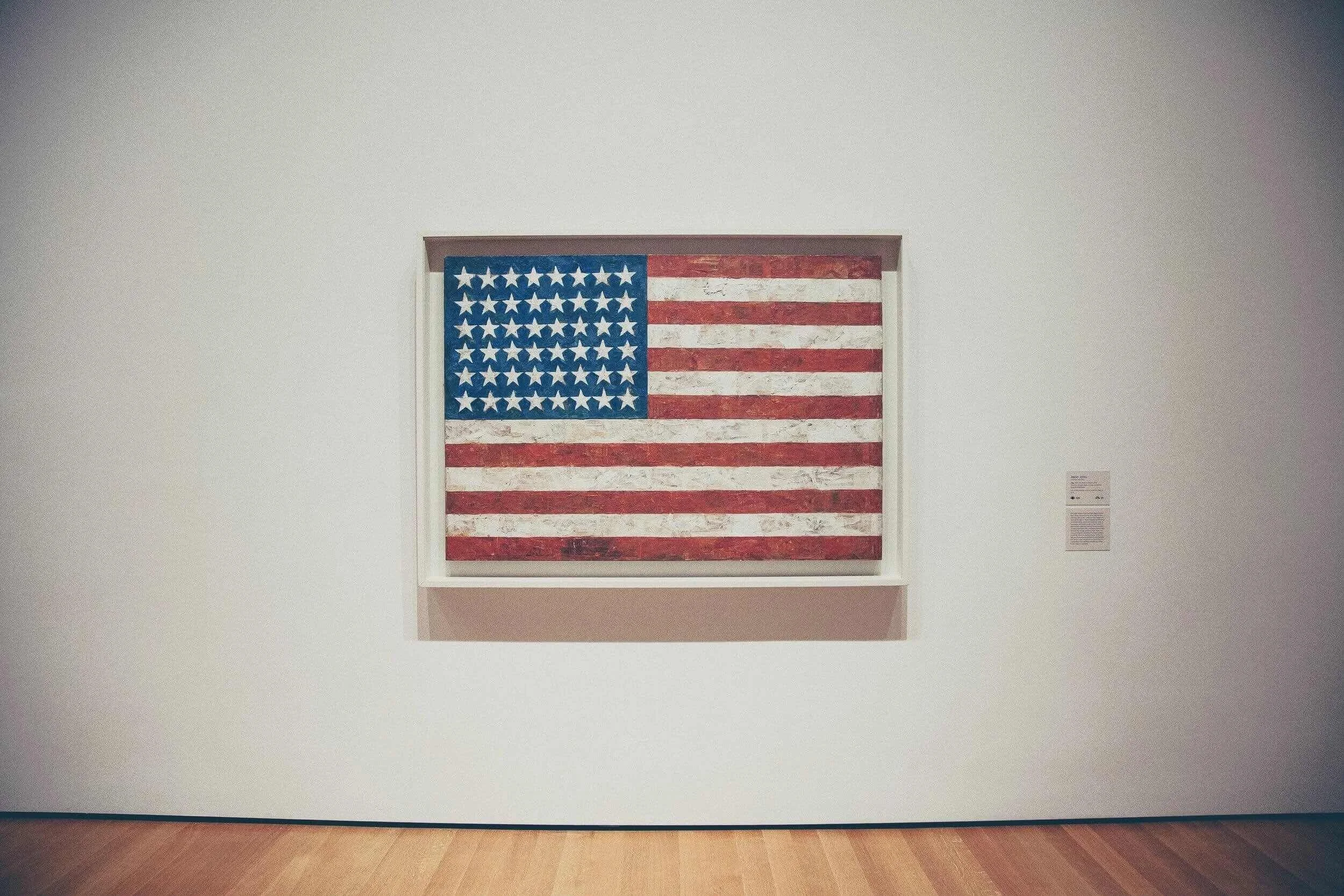
Why is the American flag red, white, and blue?
The answer turns out to be theological — but not in the way you might expect.
Let’s start with this: red, white, and blue were (and are) the colors of the British Union Jack, and indeed, the earliest American flags had 13 red and white stripes and a Union Jack in the upper left corner, where the stars are today.
And by the way, Great Britain’s flag is called the “Union Jack” because it combines multiple designs: the English flag, with its white field and red cross (St. George’s Cross, with roots in the Crusades); the Scottish flag, with its blue field and white diagonal cross (St. Andrew’s Cross); and later, in 1801, a red diagonal cross (St. Patrick’s Cross), evoking Ireland. The combination points to the union of those kingdoms under one crown — hence the “Union Jack.”
But once the American colonists declared independence from that crown, a Union Jack obviously wouldn’t do — and so they changed the American flag’s design, but not its colors (partly because textiles were expensive, and they already had red, white, and blue cloth on hand). In 1782, as the Revolutionary War raged on, the Continental Congress established the Great Seal of the United States, and in the process, officially spelled out that the new nation’s red, white, and blue colors had particular meanings. Rather than any ties to the Union Jack, the colors stood for three virtues, three values, three ideals.
Red stood for courage. White stood for purity (today we might say, “integrity” or “decency”). And blue stood for justice.
Courage, integrity, and justice. That’s what the red, white, and blue of Old Glory stand for, according to the official documents of the Continental Congress. That’s what we’re “pledging allegiance” to when we pledge allegiance to the flag, along with the Republic for which it stands.
OK, you might say. That’s interesting, I suppose. A little morsel of American trivia, some nerdy knowledge to impress your friends at a July 4th barbecue.
But hold on — there’s more going on here. Remember, this is the late-eighteenth century, and these “United States of America” were doing something provocative, something new.
They were breaking away, striking out in a different direction. Their new flag, they declared, would serve as a sign that the nation being born would be based on ideals — not on ethnicity, bloodline, kingship, or kinship. For what is a monarchy, after all, but a bloodline, a “royal family”? The monarch belongs to the special lineage, and the people — the “royal subjects” — belong to the monarch. But this new place, this “United States of America,” would turn all that upside down. The government would belong to the people, and the nation would be based on ideals the people prized.
Nor would the new nation be based on any particular national origin, clan, or caste. The Union Jack clearly signals England, Scotland, and eventually Ireland — but the American flag does no such thing.
Nor would the new nation be based on any particular religion. In those days, many national European flags (or their equivalents) featured a cross or crosses, including in Great Britain, Denmark, Sweden, Portugal, Spain, and France, among others. But the American flag? No cross at all.
It’s a striking, conspicuous absence. We should notice it every time we see the flag. The Union Jack has three crosses; the American flag, not one. And with all this in mind, it’s clear that so-called “Christian nationalism” isn’t only a theological contradiction in terms — it’s also deeply anti-American, going all the way back to the founding.
Courage, integrity, justice — and no cross. No crescent. No Star of David. No Buddha. No Shiva. Instead, 13 stripes and a constellation of stars representing the community itself, as if to say: this nation shall not be built on any particular state religion (as, say, Great Britain’s Church of England), just as it shall not be built on any particular clan, national origin, ethnic bloodline, or royal family.
No, on the contrary, this nation will be built on ideals. We will ground ourselves in them as best we can, and strive to live them out — and when we fail, we’ll get up and strive again, and again, and again. Courage. Integrity. Justice.
In a sense, the American flag is an early, visual expression of the impulse that would give rise to the United States Constitution’s First Amendment nearly a decade later, along with the Bill of Rights as a whole, and indeed the long history of our struggle ever since to live up to those ideals. That struggle continues, of course, and has entered a new chapter today. But whenever we catch sight of the American flag, we can remember that bold, world-changing message:
Not a state religion, but freedom of religion (including the freedom to practice no religion at all, the freedom without which no religion can ever truly be free).
Not a particular clan or national origin, but a shimmering, diverse constellation of origins.
Not the divine right of kings, or a royal bloodline, or a single ethnic identity, but rather a community of equals, where everyone has the right to life, liberty, and the pursuit of happiness. We’re still working on it, and we’ve got a ways to go — but that’s the vision, that’s the goal, there up ahead on the horizon, snapping in the wind: red, white, and blue.
Perhaps that’s partly why we so often put our flags up on poles: to call to mind our highest ideals, and to remind us to reach for them.
Two and a half centuries ago, the American flag was a glimpse of a new kind of community. And today, at our best, that community is still what we stand for. It’s still the Republic for which we stand.
Happy Fourth!
Peace,
The SALT Team